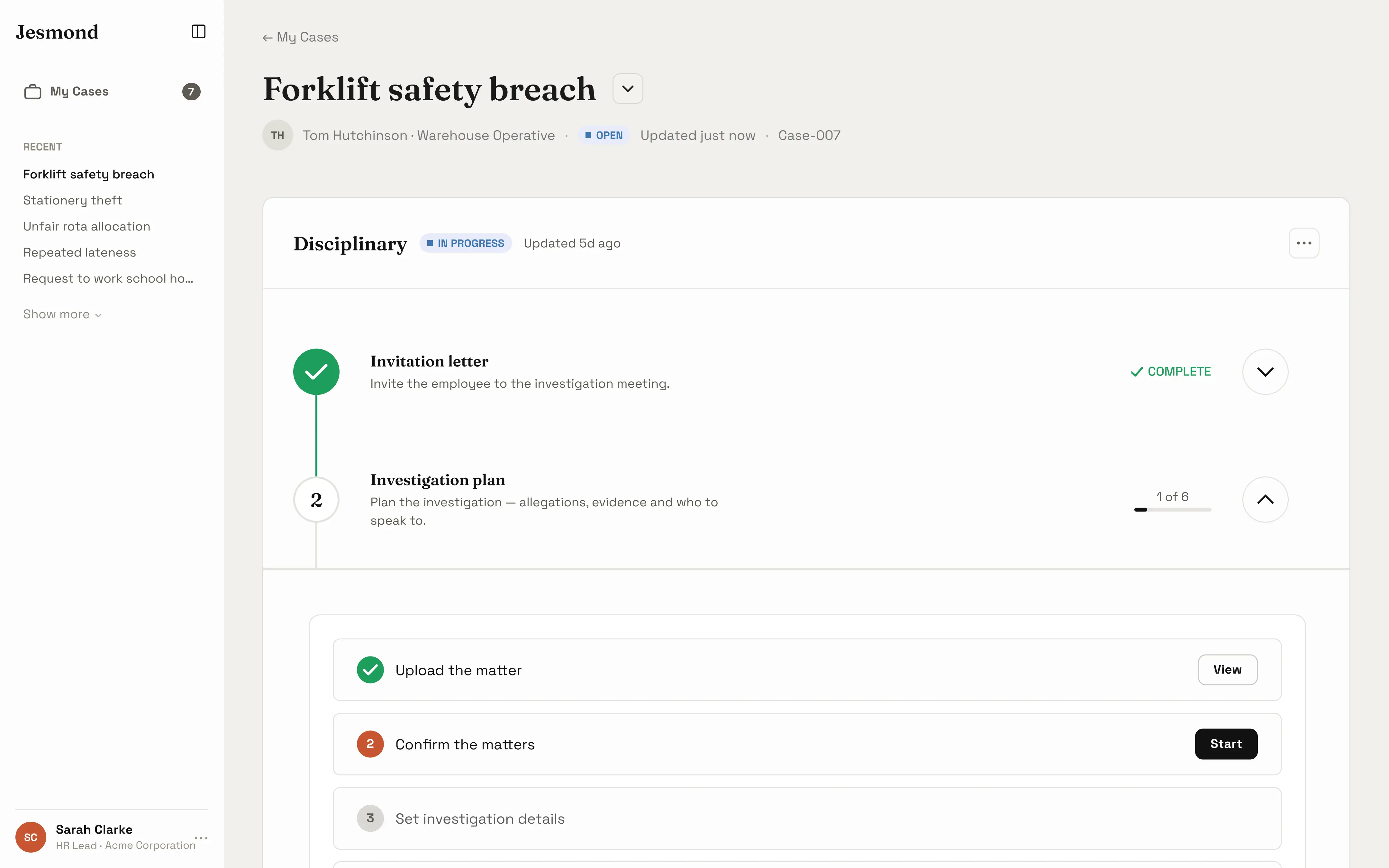
Disciplinary
CompleteOutcome letter issued and the file closed.
Fair procedures, on a defensible record
Jesmond guides a manager through a disciplinary, grievance, flexible working request or appeal, step by step. It reads what you upload, proposes the questions to ask, and assembles your findings into working papers. It does not decide anything — the findings and the words are yours.
Built forDisciplinariesGrievancesFlexible working requestsAppeals
Built by practising employment barristers, each ranked by Legal 500 or Chambers and Partners.
Case content is encrypted on your device. DefendThis holds no key to it.
Why Jesmond
Getting internal processes right has never been more important for employers. Changes to the qualifying period for unfair dismissal and the removal of the statutory cap have increased the risk of costly litigation. New flexible working request duties mean employers need to be able to evidence their careful, reasoned decisions when employees seek changes to their work.
374,760
formal grievances in the UK each year
at an average cost of £951 in management time
Source: Acas
1.7 million
disciplinary cases each year
at an average cost of £1,141 per case
Source: Acas
2 in 5
workers experienced conflict at work last year
the highest level ever recorded in Great Britain
Source: Acas, 2025 (44%)
An employee can now produce pages of plausible-sounding complaints almost immediately. Every page still has to be read and answered properly by their manager.
The qualifying period falls to six months and the cap on the compensatory award is removed. Even a small error in an internal process can increase the chance of litigation and result in a higher award or settlement.
Every internal process managers run can turn into an uncapped liability if it is mishandled.
What Jesmond is
Built by the barristers who take processes like yours apart, Jesmond runs a case from the first letter to the final outcome: allegations framed properly, the investigation kept complete, and the reasoning free of internal inconsistencies.
Outcome letter issued and the file closed.
Six findings, each answered against the complaint.
The statutory clock, held against the request.
Grounds matched to the original record.
How Jesmond helps
Each tool takes one stage at a time and asks one or two questions at a time. Nothing is pre-selected for you, and nothing moves on until you say so.
Jesmond proposes the questions and the structure. Every finding, reason and word in the outcome is yours. Where a fact is missing, the draft highlights it and says TO BE CONFIRMED instead of inventing one.
Jesmond and its parent company cannot access your data — only the admin within your own organisation determines who can. Everything is encrypted in transit and at rest, processed in the United Kingdom, and never used to train the model.
How Jesmond works
01
Jesmond digests the detail of the allegations or request. It reads the documents and understands them, breaks the issues into a list of clear factual questions, and produces a complete procedural plan covering the investigation and the decision making. That plan is yours to edit.
02
You note or record your meetings in your normal way and upload the notes. Jesmond organises and processes what people have said, and considers the evidence issue by issue.
03
When you are ready to make your decision, Jesmond presents you with the relevant evidence and asks you a series of clear questions about the findings you wish to make. Where your responses do not fit with the evidential record, it prompts you to look again at the evidence so you know you have been thorough. If your findings raise new questions, it asks them.
04
Jesmond builds a comprehensive and professional outcome document in numbered paragraphs, downloadable as a Word file. Anything your managers have not provided is not made up: a placeholder appears highlighting what is missing. An audit trail sets out what was provided and decided at each step.
What changes for you
The same record in every case: what was alleged, what was investigated, who decided what, and on what material. The board gets a clear answer when it asks what the organisation is doing about conduct and grievance risk.
Procedural risk · all sites
Live▼ 38% this yearCase volumes by quarter across every site, falling through the year.
A large share of external legal cost goes on routine drafting, and on advisers confirming that a letter says what it should. Jesmond produces that first draft to a standard your advisers will be happy with.
External review · per case
External review per case falls by 62% with Jesmond.
In any sizeable organisation the policy is applied in practice by several hundred line managers, most of whom will only rarely run disciplinaries and grievances. Jesmond is configured with your policies, your definitions and your escalation rules, and applies them the same way wherever the case arises.
One policy · every site
Employee relations teams, who carry the administrative and often emotional burden of coordinating and supervising grievance and disciplinary processes, get their time back. Management on the ground, who may lack time, skills or confidence in dealing with these processes, are able to hit the ground running and with assurance.
Where the hours go
per case9hours of drafting
off the desk
Everything in an internal file is disclosable, and a tribunal reads it as it stands. Jesmond checks the outcome against the original complaint and the evidence before it goes out, so the allegations stay consistent from the invitation letter through to the decision. Most importantly, every point raised receives an answer.
Grievance outcome
4/4 answeredThe procedures
Procedural failings are a routine reason for dismissals being found unfair, however sound the underlying reason was. Jesmond covers the process from the first letter to the final decision, on every site, with or without HR in the room.
Allegations clear and well defined, possible outcomes exactly as you set them, the right to be accompanied included, nothing prejudged.
The matters to look into, the people to interview and the documents to gather, with a neutral question script for every interview.
The unspoken-to witness and the missing document flagged before the hearing, while there is still time to put that right.
A chair’s script that runs the same on hearing one and hearing fifty: each allegation put exactly as set, the evidence summarised neutrally.
Findings, mitigation and sanction recorded in your words, produced as two documents: the decision and the outcome letter.
The team
Jesmond is designed, owned and run by practising employment barristers, working with senior advisers drawn from employment law, legal practice and AI research. The people who built Jesmond handle employment cases for a living.

Outer Temple Chambers
Called to the Bar in 2015. Practises in employment, commercial litigation, pensions and professional negligence, and regularly conducts internal investigations on behalf of organisations.
“A very hard-working and very talented barrister who stays calm under pressure and is a great team player.” — Legal 500, 2026

12 King's Bench Walk
Called to the Bar in 2015 and head of the employment team at 12 King's Bench Walk. Practises in personal injury and employment, and acts in cases of abuse, harassment and bullying.
“David Green is superb on every level.” — Chambers & Partners, 2026

Littleton Chambers
Called to the Bar in 2013. Practises in employment and sports litigation, complex discrimination and High Court business protection, and is frequently appointed to conduct investigations.
“Grahame’s technical skill and attention to detail are absolutely forensic.” — Chambers & Partners, 2026

Outer Temple Chambers
The UK’s leading human resources and employment law commentator. Founder of three companies in legal training and technology, author of over 30 textbooks and presenter of The Legal Hour on LBC Radio.
“Daniel Barnett is a gamechanger in employment law.” — Chambers & Partners, 2026
Charles Wynn-Evans
Led Dechert’s London employment team for 24 years, and wrote The Law of TUPE Transfers.
Liz Dux
A solicitor of 30 years at Slater and Gordon, latterly Chambers Director at Littleton Chambers.
Professor Tim Rocktäschel
Founder of a $650M-funded AI company, and Professor of AI at UCL.
Confidentiality
Processed in the United Kingdom. Hosted on UK or EU infrastructure as agreed with each client, each tenant logically separated, everything encrypted in transit and at rest.

To be one of the first organisations to get access to Jesmond, please join our priority list.